Creator Guide
What Is BPM? Tempo Explained for Musicians, Producers and DJs
BPM, or beats per minute, tells you how fast a piece of music moves. It is the number a producer types into a DAW before recording anything, the figure a DJ checks before mixing two tracks, and the reason one song makes you nod slowly while another makes you want to run.
This guide explains what BPM really measures, why the same song can seem to have two different tempos, how tempo varies across genres, and how to use it for practical jobs such as working out song length or setting delay times.
What BPM actually measures
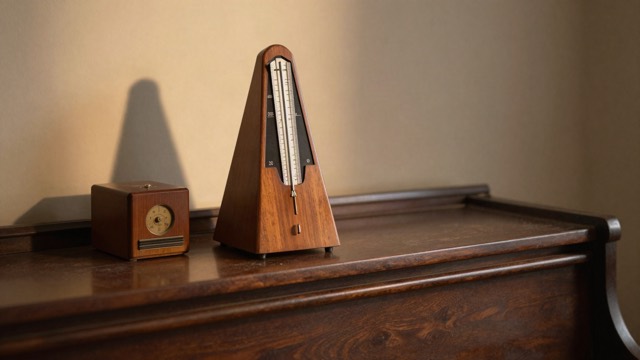
A beat is the steady pulse you would naturally clap or tap along to. BPM counts how many of those pulses happen in sixty seconds. At 60 BPM there is exactly one beat per second; at 120 BPM there are two beats per second, so each beat lasts half a second.
That relationship gives you the single most useful formula in rhythm work:
So one beat at 100 BPM lasts 600 milliseconds, and at 128 BPM it lasts roughly 469 milliseconds. Everything else — bar lengths, loop lengths, delay times, song durations — builds on this number.
Beats, bars and time signatures
Beats are grouped into bars (also called measures). The time signature tells you how many beats sit in each bar. Most pop, hip-hop, Afrobeats, Amapiano, house and R&B is in 4/4, which means four beats per bar. A waltz is in 3/4, three beats per bar. BPM and time signature are separate ideas: tempo tells you how fast the beats go, the time signature tells you how they are grouped.
In 4/4 at 120 BPM, one bar lasts two seconds (four beats of half a second each). An eight-bar verse therefore lasts 16 seconds, and a 16-bar verse lasts 32 seconds.
Why the same song can have two tempos
Ask three people to tap along to a trap beat and you may get three answers: 70, 140 and occasionally 280. None of them is exactly wrong. They are tapping at different levels of the rhythm.
- Half-time feel puts the snare on beat three instead of beats two and four, so the track feels slow even when the hi-hats are racing. Much trap and drill is produced at around 130–150 BPM but feels like 65–75.
- Double-time is the opposite: listeners tap on every eighth note, doubling the reading.
The convention is to quote the tempo the producer set in the session, which usually matches where the kick and snare pattern sits. If a reading seems strange for the feel of a song, halve or double it and ask which number matches the groove. Our BPM tap calculator shows the half-time and double-time figures next to every reading for exactly this reason.
Typical tempo ranges by genre
Genres do not have fixed tempos, and producers break these ranges all the time. Still, most tracks in a style cluster around a familiar pace, and knowing it helps when you are starting a beat or building a DJ set. The figures below are approximate.
| Style | Approximate range (BPM) | Notes |
|---|---|---|
| Slow R&B and ballads | 60–80 | Often felt in a relaxed half-time pulse |
| Boom-bap and classic hip-hop | 85–100 | Head-nod tempo; swing is common |
| Afrobeats | 95–115 | Mid-tempo, dance-friendly; many songs sit near 100–110 |
| Amapiano | around 108–118 | Unhurried house tempo with long builds |
| Reggaeton and dancehall | 85–105 | Built on the dembow and related patterns |
| Mainstream pop | 95–130 | Very broad; depends on the era and mood |
| House | 118–128 | Four-on-the-floor kick |
| Techno | 125–145 | Some styles push well above this |
| Trap and drill | 130–150 (felt at half) | Usually programmed fast, felt slow |
| Drum and bass | 160–180 | Often around 170–175 |
If you want to hear how two of these styles relate, our feature on what Amapiano is and the Afrobeats hub both explain how tempo and groove shape each sound.
Classical tempo markings
Before metronomes were common, composers described tempo with Italian words. You will still see them in sheet music and some DAW presets. Their meanings are approximate and different sources give slightly different ranges:
- Largo / Lento — very slow, roughly 40–60 BPM
- Adagio — slow, roughly 65–75 BPM
- Andante — walking pace, roughly 75–105 BPM
- Moderato — moderate, roughly 100–120 BPM
- Allegro — fast and bright, roughly 120–155 BPM
- Presto — very fast, roughly 165 BPM and above
These words also describe character, not just speed. An andante should feel like it is walking, whatever the exact number.
How tempo shapes a song
Feel and energy
Tempo is one of the strongest signals of mood. Faster tempos generally read as energetic or urgent; slower tempos give vocals room to breathe and make space for detail. But the perceived energy also depends on rhythm density. A 100 BPM Afrobeats track with busy percussion can feel livelier than a sparse 125 BPM house groove.
Vocals and lyrics
Singers and rappers need space to deliver words clearly. A rapper who writes dense, syllable-heavy verses may prefer a slower tempo with room for double-time flows. A melodic hook often works best at a pace where each sustained note can land comfortably. If a demo feels rushed, try dropping the tempo by three to five BPM before rewriting anything.
Song length
Tempo directly controls how long a given arrangement lasts. The formula is:
Take a 4/4 song with 96 bars. At 100 BPM, that is 384 beats × 0.6 seconds = 230.4 seconds, or about 3 minutes 50 seconds. Push the same arrangement to 110 BPM and it drops to roughly 3 minutes 29 seconds. The song duration calculator does this maths for you, including different time signatures.
Practical uses for BPM
Setting delay and reverb times
Delays that match the tempo sit inside the groove instead of cluttering it. A quarter-note delay equals one beat (60,000 ÷ BPM), an eighth-note delay is half that, and a dotted eighth is three-quarters of a beat. At 120 BPM that gives 500 ms, 250 ms and 375 ms respectively. Most plug-ins can sync automatically, but knowing the numbers helps with hardware and with pre-delay on reverbs.
DJing and mixing tracks together
DJs match the tempo of two tracks so their beats line up during a transition. Small differences can be corrected with a pitch fader or time-stretching; larger jumps usually call for a creative transition or a half-time or double-time blend. Knowing each track's BPM lets you plan a set that rises and falls deliberately.
Remixes, samples and edits
When you sample or remix, you need the original tempo so you can stretch or loop material cleanly. If you do not have it, our guide on how to find the BPM of a song walks through tapping, counting and using software.
Choosing a tempo for a new track
There is no correct tempo, but a few questions help:
- What will listeners do to it — dance, drive, study, work out?
- What range does the style usually use, and do you want to sit inside it or push against it?
- Does the vocal feel natural at this pace? Record a rough take before committing.
- Will a DJ want to mix it with similar songs? Staying near a genre's common range makes that easier.
Common BPM mistakes
- Confusing speed with energy. Arrangement, drums and mix density matter as much as the number.
- Ignoring half-time and double-time. Always sanity-check a reading against the feel.
- Assuming a constant tempo. Many live recordings drift, and some songs change tempo deliberately. A single figure is an average.
- Forgetting swing. Swung or shuffled grooves still have a BPM; the swing changes the placement of off-beats, not the pulse.
Key takeaways
- BPM is the number of beats per minute; one beat lasts 60,000 ÷ BPM milliseconds.
- Tempo and time signature are different things: one is speed, the other is grouping.
- Many songs can be read at half or double their tempo — go with the pulse the drums imply.
- Genre tempo ranges are loose guides, not rules.
- Tempo changes song length: use bars × beats × 60 ÷ BPM, or the song duration calculator.
- Measure an existing track with the BPM tap calculator, then learn how tempo interacts with harmony in how song keys work.